

Living in Chesapeake VA (2026): Neighborhoods, Commutes, Flooding, and What Buyers Should Know
If you’re trying to figure out whether Chesapeake, Virginia, is a “nice place to live,” this isn’t going to help you.
It probably is. Most places are, depending on who you ask.
What actually matters, and what most people don’t realize until after they’ve already bought, is that living in Chesapeake can look completely different depending on where you land and how you structure the decision.
Two people can both say they “live in Chesapeake” and have almost nothing in common day to day.
One is on acreage with space, quiet, and a 35 to 45 minute commute.
Another is near Greenbrier with quick access to everything, but closer neighbors and more traffic.
Someone else is dealing with flood insurance considerations that never even crossed their mind when they started looking.
Same city. Completely different experience.
That’s where most of the frustration comes from. Not the city itself, but the mismatch between what someone thought they were buying into and how it actually plays out once they’re living there.
If you’re relocating, moving up, or just trying to make a smarter decision this time around, the goal isn’t to figure out if Chesapeake is “good.”
The goal is to understand where it fits, what tradeoffs come with each area, and how to choose the version of Chesapeake that actually works for your life.
At a Glance: Living in Chesapeake VA
Chesapeake is spread out, not centralized
There isn’t a single “downtown” that defines the city. Different areas operate almost like separate pockets with their own feel, commute patterns, and price ranges.Price and lifestyle vary significantly by area
The experience at $500K can look very different from $800K or $1M+, depending on location, lot size, age of home, and proximity to commercial areas.Space vs. commute is the core tradeoff
More land and quieter surroundings typically come with longer drive times. More convenience and access usually means less space and more density.Flooding is location-specific, not city-wide
Some properties require additional insurance or due diligence, while others have no flood-related considerations at all. It depends on the specific property and zone.Different price points create completely different buying experiences
Inventory, competition, and negotiation dynamics shift as you move up in price, especially in higher ranges where inventory can be more limited.Buyers often compare Chesapeake with nearby areas
Common comparisons include Virginia Beach, Norfolk, Suffolk, and Moyock, each offering different balances of space, access, and lifestyle.
Where Chesapeake is in Hampton Roads (And Why People Choose It)
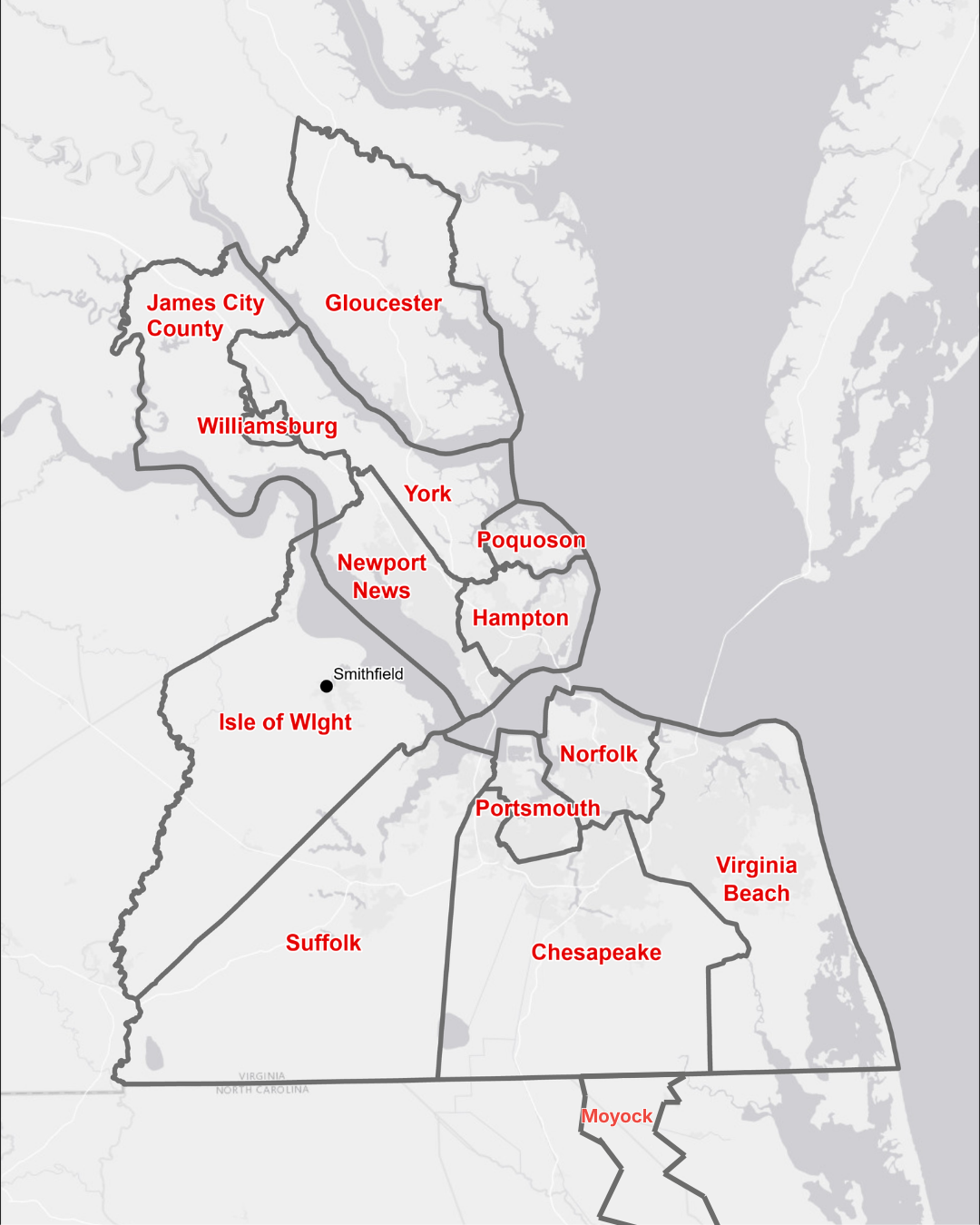
Here’s a simple regional map showing Chesapeake in relation to Virginia Beach, Norfolk, Suffolk, Moyock, NC and the surrounding areas in Hampton Roads)
Chesapeake sits in a unique position within Hampton Roads. It’s directly connected to Virginia Beach and Norfolk, with access to Suffolk on the western side, which makes it a common consideration for buyers trying to balance space, access, and price.
That positioning is a big part of why people land here.
You can be within driving distance of major employment centers, shopping, and the coast, while still having options for larger lots, newer construction in certain areas, or more separation from dense, built-up surroundings.
But this is also where a lot of people misjudge Chesapeake.
On a map, it looks like one cohesive area. In practice, it doesn’t function that way.
Different parts of Chesapeake can feel far removed from each other in terms of daily convenience. A location that works well for someone commuting to Norfolk or Virginia Beach may feel very different from one that’s positioned further west or more rural.
That’s why most buyers don’t struggle with whether Chesapeake is a good option. They struggle with which part of Chesapeake actually fits how they live day to day.
And that decision tends to come down to how you balance space, access, and what you’re willing to drive for on a regular basis.
The 4 Things That Actually Shape Your Experience Living in Chesapeake
Most people start their search focused on price, number of bedrooms, or whether a home “looks right.”
But in Chesapeake, those things don’t determine how your day-to-day life actually feels.
These four factors do.
1. How Does Space vs. Convenience Affect Where You Should Live in Chesapeake?
One of the biggest tradeoffs in Chesapeake is space versus proximity.
In many areas, you can get larger lots, newer construction, or more separation between homes. That’s a big part of the appeal. But it usually comes with longer drive times to everyday destinations like shopping, work, or activities.
On the other hand, areas that are closer to commercial centers or major roadways tend to offer quicker access, but with smaller lots, more traffic, and a more built-up feel.
This isn’t a right or wrong decision. It’s a lifestyle decision.
The mistake most buyers make is assuming they can get both without compromise. In reality, most choices in Chesapeake lean one direction or the other, and the right answer depends on what you value on a daily basis.
2. What Are Commute Patterns Like in Chesapeake VA?
Commute patterns play a bigger role in Chesapeake than many buyers expect, and they’re not something you can judge accurately just by looking at a map.
A large portion of traffic is influenced by:
Naval Station Norfolk and other military-related employment centers
Jobs in Virginia Beach
Buyers who work remotely but still need regular access to surrounding areas
Because Chesapeake is spread out, your commute experience can vary significantly depending on where you’re located and where you need to go.
Two homes that seem relatively close can produce very different drive times once you factor in traffic patterns, peak hours, and major routes.
This is where many buyers get caught off guard, especially if they’re relocating.
What tends to work best is evaluating commute based on your actual routine, not just distance. That means looking at:
Where you’ll be driving during the week
What time of day those drives happen
How consistent that schedule is
A route that feels manageable at one time of day can look very different during peak traffic.
That’s why commute planning is usually something that gets mapped out alongside the home search, rather than after a property is chosen.
3. Does Flooding Affect Homes in Chesapeake VA?
Flooding is something buyers ask about often, and the answer is more nuanced than most expect.
It’s not a city-wide issue, and it doesn’t affect every property the same way.
Flood considerations depend on:
The specific property
The flood zone designation
Whether the home is waterfront or inland
Some homes may require flood insurance, while others have no flood-related requirements at all.
The key is evaluating each property individually rather than making assumptions based on the city as a whole.
(Future internal link: “Flood Zones and Insurance in Chesapeake VA: What Buyers Need to Know”)
4. How Do Different Price Points Change Your Experience in Chesapeake?
Price doesn’t just change the size or condition of a home. It changes the type of choices available to you.
As you move through different price ranges, you’ll see shifts in:
Location options
Lot size and spacing
Age of homes and level of updates
Inventory availability and competition
In higher price points, inventory can become more limited, and factors like appraisal sensitivity or property-specific features start to play a larger role.
That’s why two buyers searching in different price ranges can have completely different experiences, even if they’re both looking in Chesapeake.
We’ll break that down more clearly in the next sections.
Chesapeake Neighborhood Breakdown (Where the Differences Show Up)
Once you start narrowing down options, the differences between areas in Chesapeake become much more noticeable.
At a high level, you’re not just choosing a home. You’re choosing how your day-to-day life will function based on location, access, and property type.
Below is a simplified breakdown of how different areas tend to compare.
What Are the Main Areas to Consider When Buying in Chesapeake VA?
Hickory
Often considered when buyers are looking for more space, newer construction in certain pockets, and properties with larger lot sizes.
This area is typically further from more commercial centers, which can impact commute times depending on where you work or travel regularly.
School zoning is something many buyers research here, along with property type and land availability.
Read more about Hickory in our: Hickory Area Guide - Living in Hickory
Great Bridge
Offers a more central feel within Chesapeake, with a balance between residential areas and access to shopping, dining, and major routes.
Buyers often look here when trying to balance convenience with neighborhood-style living.
Property types and price points can vary, which gives buyers more flexibility depending on their priorities.
Read more about Great Bridge in our: Great Bridge Area Guide (Coming Soon)
Greenbrier
One of the more convenience-driven areas, with closer proximity to commercial centers, retail, and major roadways.
This location tends to appeal to buyers who prioritize accessibility and shorter drives to everyday amenities.
Homes here are generally on smaller lots compared to more rural parts of Chesapeake, with a more built-up surrounding environment.
Read more about Greebrier in our: Greenbrier Area Guide (Coming Soon)
What Other Areas Should You Know About in Chesapeake VA?
Grassfield
Often overlaps with conversations around Hickory, with newer construction in certain sections and a mix of property types depending on the specific location.
Deep Creek
Offers a mix of older homes, newer builds, and a range of price points.
Some buyers look here for value opportunities, depending on condition, location within the area, and commute considerations.
Western Branch
Positioned closer to Suffolk, which can create a different commute dynamic depending on where you need to go.
Often part of the conversation for buyers weighing space and price against travel time.
South Norfolk
More urban in feel compared to other parts of Chesapeake, with a mix of older homes, redevelopment, and newer construction in certain pockets.
Location and proximity to surrounding cities tend to be key factors here.
What Different Price Points Actually Look Like in Chesapeake VA
Price in Chesapeake doesn’t just change the size of the home. It changes where you can realistically buy, what types of properties are available, and how many options you’ll have to choose from.
Two buyers with different budgets can have completely different experiences, even if they’re both searching in the same city.
Here’s how that tends to break down.
What Can You Expect Under $500K in Chesapeake VA?
In this range, buyers are typically choosing between:
Older homes that may need updates
Smaller homes in more central or established areas
Attached homes, townhomes, or condos in certain pockets
Attached and condo-style living is more commonly found in areas like Greenbrier and other convenience-driven parts of Chesapeake, where proximity to shopping, major roads, and commercial centers is a priority.
In some cases, these types of properties can offer a lower entry point compared to detached homes, but availability depends heavily on location and current inventory.
At this price point, the main tradeoffs usually involve:
Condition and level of updates
Location within the city
Property type (detached vs attached)
Buyers in this range often have to prioritize what matters most rather than getting everything on their list.
What Does $500K–$700K Get You in Chesapeake VA?
This is where more options start to open up.
Buyers may begin to see:
Larger homes or more updated properties
More detached single-family homes
Some newer construction, depending on the area
Location still plays a major role here.
In some parts of Chesapeake, this range can offer more space and newer homes. In others, it may still involve tradeoffs depending on proximity to more central areas.
Most decisions in this range come down to:
Size vs location
Newer construction vs established neighborhoods
What Changes in the $700K–$1M Range in Chesapeake VA?
This is where many move-up buyers land, and where the range of choices becomes more defined.
Buyers often see:
Larger homes with more intentional layouts
Better alignment between location, condition, and space
More consistency in property quality
At this level, the tradeoffs don’t disappear. They just become more specific.
Instead of broad compromises, buyers tend to weigh:
Exact location within an area
Lot size and privacy
Specific features or upgrades
Inventory and competition can also vary depending on the segment of the market and time of year.
What Can You Expect at $1M+ in Chesapeake VA?
At this level, the market becomes more selective.
Buyers may find:
Waterfront properties
Homes with acreage
Newer or more customized builds
Inventory is typically more limited, and homes tend to be more property-specific in terms of features, location, and appeal.
Because of that, factors like:
Pricing strategy
Appraisal considerations
Property uniqueness
start to play a larger role in how transactions move.
Buyers in this range are often evaluating fewer options, but with more attention to detail in each one.
- Smaller or older homes
- Attached homes, townhomes, or condos in select areas
- Tradeoffs: updates, location, property type
- More detached homes available
- Some newer construction
- Tradeoffs: size vs location
- Larger homes, more consistency in quality
- Better balance of space and location
- Tradeoffs: lot, layout, upgrades
- Waterfront, acreage, or newer builds
- More selective inventory
- Tradeoffs: uniqueness, pricing, appraisal
What It Costs to Live in Chesapeake VA (Beyond the Purchase Price)
The purchase price is only part of what it takes to own a home.
What tends to catch buyers off guard isn’t the mortgage. It’s everything else that comes with maintaining, operating, and holding the property over time.
In Chesapeake, those costs can vary widely depending on the home, the location, and how the property is set up.
Here’s how to think about it.
What Taxes Should You Expect When Living in Chesapeake VA?
Property taxes are the most obvious, but they’re not the only local taxes homeowners should be aware of.
In addition to real estate taxes based on assessed value, Chesapeake also includes things like:
Personal property taxes on vehicles
Taxes or licensing requirements related to certain animals
These costs vary based on what you own and how it’s registered, so they don’t impact every household the same way.
The key is understanding that your total tax exposure isn’t just tied to the home itself, it’s tied to your overall situation.
Do You Need Flood Insurance in Chesapeake VA?
Flood insurance is not required for every home, but it does come into play in certain locations.
Whether it applies depends on:
The specific property
Its flood zone designation
Lender requirements
Some homes will never require it. Others will.
The important part is evaluating this on a property-by-property basis rather than assuming it applies to the entire city.
Read the full article: Flood Zones and Insurance in Chesapeake VA (Coming Soon)
How Do HOA Fees Work in Chesapeake VA (And What Should You Watch For)?
HOA fees can vary significantly depending on the community and type of property.
Some neighborhoods have no HOA at all. Others include monthly or annual fees that cover anything from basic maintenance to more structured community oversight.
Attached homes, townhomes, and condos are more likely to include HOA dues, especially in areas closer to shopping, major roads, and commercial centers.
What matters most is not just the amount of the fee, but how it functions over time.
When evaluating an HOA, it’s worth looking at:
How often fees have increased historically
What the fee actually covers
The condition of shared areas and infrastructure
Whether there are adequate reserves for future repairs
In some communities, fees remain relatively stable and align with the level of upkeep provided. In others, fees may increase regularly without a clear improvement in services or amenities.
Understanding how an HOA is managed can make a noticeable difference in your long-term ownership experience.
What Should You Budget for Maintenance and Upkeep in Chesapeake VA?
Maintenance is one of the most underestimated parts of owning a home.
Unlike rent, where most major expenses are handled for you, homeownership means you’re responsible for everything, both expected and unexpected.
Some costs show up gradually. Others come in large chunks.
Over time, homeowners typically need to account for things like:
Roof replacement (often in the range of 20 to 30 years depending on materials and upkeep)
HVAC systems, water heaters, and major appliances
Exterior maintenance like pressure washing, siding care, and landscaping
Pest control, especially in more wooded or damp areas
Routine servicing of systems like fireplaces, crawlspaces, or attics
Even smaller recurring costs can add up:
Air filters and basic upkeep supplies
Lawn treatments or mosquito control
Cleaning, repairs, and general wear and tear
One common approach is setting aside a percentage of the home’s value each year for maintenance, though the exact amount depends on the age, condition, and size of the property.
A newer home may require less upfront, but that doesn’t eliminate future costs. An older home may require more attention sooner.
The key is not trying to predict every expense, but being prepared for the reality that they will happen.
What People Worry About (And What’s Actually True About Living in Chesapeake VA)
When buyers look at Chesapeake, a few concerns tend to come up consistently.
Most of them are valid. The difference comes down to how they actually show up in day-to-day life.
Does Flooding Affect Homes in Chesapeake VA?
Flooding is one of the most common concerns, but it’s not as simple as whether a home is in a flood zone or not.
Some properties may require flood insurance. Others don’t.
But even when a home itself is not at risk, flooding can still affect how you live in that location.
In certain areas, heavy rain can impact:
Roads leading in and out of neighborhoods
Low-lying intersections or common routes
How easily you can get where you need to go during storms
For some buyers, this may not be a major issue. For others, especially those with fixed schedules or time-sensitive jobs, it can be a significant consideration.
The key is not just asking:
“Does this house require flood insurance?”
But also:
“How does water move in and around this area when it rains?”
That’s the part that often gets missed.
Read the full article: Flood Zones and Insurance in Chesapeake VA (Coming Soon)
What Should You Know About Hurricanes When Living in Chesapeake VA?
Hurricanes are part of living in a coastal region, and while Chesapeake is further inland than areas like Virginia Beach, it can still be affected depending on the storm.
What that impact looks like can vary based on:
Wind and rainfall levels
Tree coverage around the home
Drainage and surrounding infrastructure
In stronger storms, there can be:
Power outages
Downed trees or debris
Temporary road flooding or closures
In more severe scenarios, evacuation orders may be issued depending on location and conditions.
Because of that, it’s important for homeowners to:
Be aware of local evacuation routes
Understand how their specific area may be affected
Have a basic plan for preparation if needed
For official guidance on emergency preparedness and evacuation planning, you can refer to:
Ready.gov (National emergency preparedness guidance)
These resources provide current recommendations based on conditions and location.
H3: How Do Traffic and Bridge Openings Affect Daily Life in Chesapeake VA?
Traffic is one of the most noticeable day-to-day factors, but what often surprises buyers is how specific it can be to your route.
In addition to typical peak-hour patterns, certain areas are affected by bridge openings.
Some bridges operate on scheduled lift times, which can:
Occur at regular intervals, sometimes as frequently as every 30 minutes
Pause traffic for 10 to 15 minutes at a time
Create delays if you’re not planning around them
This can make a meaningful difference in your routine.
For example, a drive that normally takes 30 minutes may require a larger time buffer depending on timing and route.
What tends to help is:
Knowing whether your route includes a bridge
Understanding typical lift schedules
Being aware of alternate routes when available
There are public resources available that provide bridge lift schedules and traffic updates, which can help you plan more accurately.
Who Chesapeake Works For (And Who Usually Ends Up Frustrated)
Chesapeake can be a great fit, but it’s not a one-size-fits-all market.
Most of the satisfaction or frustration comes down to how well the location, layout, and daily logistics align with how you actually live.
Who Does Chesapeake VA Tend to Work Well For?
Buyers who prioritize space and separation
Many areas of Chesapeake offer more space between homes, larger lots, or a quieter residential feel compared to more densely built areas nearby.
That said, how much space you get, and where you get it, varies by location. Some areas are continuing to develop and become more built out over time.
Buyers who are comfortable with driving as part of daily life
Driving is a normal part of living in Chesapeake.
Even for buyers who work locally, daily routines often include:
Highway travel
Driving to shopping or dining
Traveling to nearby cities like Norfolk or Virginia Beach for certain services or activities
Commute length depends heavily on where you work, but overall, this is not a market where most daily needs are within walking distance.
Buyers who want flexibility across different types of areas
Chesapeake offers a mix of:
More rural or low-density areas
Established residential neighborhoods
More built-up, convenience-driven sections
For example, areas like Central Greenbrier offer more proximity to shopping, restaurants, and services, with some limited walkability depending on the exact location.
Other parts of Chesapeake remain more spread out, where driving is required for most day-to-day needs.
Who Tends to Feel Frustrated Living in Chesapeake VA?
Buyers expecting consistent walkability across the city
Most areas of Chesapeake are not designed around walkability.
There are some pockets, such as parts of Greenbrier, where you may be able to walk to nearby stores, restaurants, or services depending on location.
But overall, most areas require driving for everyday activities.
Buyers who need a short or highly predictable commute without flexibility
Commute experience in Chesapeake depends almost entirely on:
Where you live
Where you work
Your route
Some buyers may have very manageable commutes, especially if they work within Chesapeake.
Others may experience longer or less predictable drive times depending on traffic patterns, bridge routes, and timing.
This is one of the biggest factors that impacts long-term satisfaction if it’s not thought through early.
Buyers expecting every neighborhood to feel the same
Chesapeake has a wide range of neighborhoods, and they don’t all offer the same experience.
You may see:
Older neighborhoods near newer construction
Differences in lot size, layout, and density
Areas that feel more established versus areas still developing
Even within the same general part of the city, the experience can vary from one neighborhood to another.
Chesapeake vs. Nearby Areas, Where the Differences Actually Matter
A lot of buyers don’t choose between “Chesapeake or not Chesapeake.”
They’re usually choosing between Chesapeake and one or two nearby alternatives, and the real differences come down to how daily life works once you’re there, including space, density, commute patterns, and access to the things you use regularly.
Chesapeake vs. Virginia Beach
As of March 2026, Virginia Beach has a population of roughly 450,000 to 460,000 people, making it the largest city in Virginia. Chesapeake, by comparison, sits closer to 250,000 to 260,000 people.
That difference in population shows up in how the areas feel.
Virginia Beach is more built out overall, with a more consistent level of density, stronger commercial concentration, and more activity across the city, especially near major corridors and coastal areas. Chesapeake, while still large geographically, tends to feel more spread out depending on where you are. There are areas that are actively developing, like Greenbrier, but there is still more variation between low-density and more built-up sections.
Where this matters most is in how your day-to-day life is structured.
Virginia Beach often offers closer proximity to the beach, more established shopping and dining areas, and a more consistently active environment. Chesapeake, on the other hand, tends to offer more space and flexibility, with the tradeoff being that you may need to be more intentional about where you live in relation to where you go regularly.
That gap has been narrowing over time as development continues, but the overall difference in how the two cities function is still noticeable.
Price also tends to play a role in this comparison.
In many cases, buyers will find that similar price points in Virginia Beach come with smaller lots, more density, or less overall space compared to parts of Chesapeake. That gap has been narrowing as both areas continue to develop, but the difference in what you get for your money can still be noticeable depending on location.
For buyers deciding between the two, it often comes down to whether they want to prioritize proximity and convenience, or whether they’re willing to step slightly further out in exchange for more space and flexibility.
Read the full article on: Chesapeake vs. Virginia Beach (Coming Soon)
Chesapeake vs. Norfolk
Norfolk has a population of roughly 230,000 to 240,000 people as of early 2026, which is similar in size to Chesapeake, but the way the city is structured is very different.
Norfolk operates as a more urban environment, with higher density in many areas, more mixed-use development, and a strong connection to military, port, and healthcare industries. Chesapeake, by contrast, is more spread out and residential in how it’s laid out, without a single centralized urban core.
This comparison tends to matter most for buyers who are working in Norfolk, especially those connected to Naval Station Norfolk or other major employers in the city.
In practical terms, Norfolk often makes sense for proximity and a more urban lifestyle, while Chesapeake tends to appeal to buyers who want more space and a different pace, while still keeping Norfolk within reach depending on the route.
And that’s where the real decision comes in.
It’s usually not about whether the distance works on paper. It’s about whether the route, traffic patterns, and timing of that commute are something you want to deal with on a regular basis.
Price and property type also factor heavily into this decision.
Norfolk tends to offer a wider range of older homes with character, including areas like Ghent where architecture, layout, and overall feel are very different from what you’ll find in more suburban parts of Hampton Roads. That uniqueness is part of the appeal, but it also means buyers are often working with older construction and different maintenance considerations.
Compared to Chesapeake, buyers may find less consistency in layout and neighborhood structure, but more variety in style and setting. In contrast, Chesapeake tends to offer more predictable residential patterns, with newer construction and more uniform neighborhood layouts in many areas.
Chesapeake vs. Suffolk
Suffolk has a population of roughly 95,000 to 100,000 people, but it is significantly larger in land area than Chesapeake, which creates a different overall feel.
In many parts of Suffolk, buyers can find more land, less density, and a slower pace. That overlap is part of why buyers often compare it to Chesapeake in the first place.
Where the difference starts to show is in access.
Chesapeake tends to sit in a more central position for buyers who need to regularly reach Virginia Beach, Norfolk, or multiple parts of the Southside. Suffolk can offer more space, but depending on where you’re located and where you need to go, the commute tradeoff can become more noticeable.
For some buyers, that tradeoff is worth it for the amount of land and separation they get. For others, Chesapeake ends up being the better balance between space and accessibility.
Price can also shift how this comparison plays out.
In many parts of Suffolk, buyers are able to get more land and more house for their budget compared to Chesapeake, especially as you move further from more central areas. That added space is part of the appeal, but it often comes with a different commute pattern depending on where work and daily activities are located.
Another factor is regional orientation.
Some buyers in Suffolk are more connected to the Peninsula, including areas like Newport News and Hampton, rather than commuting regularly across the Southside. That distinction can make a meaningful difference in how practical a location feels depending on your routine.
Chesapeake vs. Moyock
Moyock is significantly smaller, with an estimated population of roughly 5,000 to 7,000 people in the immediate area, which creates a very different scale of living compared to Chesapeake.
That smaller population translates into less overall development, fewer commercial areas, and a quieter environment in general. This is part of what attracts buyers to Moyock, especially those looking for more land or a different pace.
But the tradeoff is very specific.
Most daily travel routes in and out of Moyock rely on Highway 168, which is also the primary access route to the Outer Banks. During certain times of year, especially in the summer, that can create noticeable congestion and backup depending on the day and time.
So while Moyock offers more space and less density, it also comes with a more concentrated traffic pattern due to limited route options.
Chesapeake, by comparison, offers more flexibility in how you get around, along with a wider range of neighborhoods and access points to different parts of Hampton Roads.
For some buyers, Moyock is the right fit because they want that separation and are comfortable with the commute dynamics. For others, Chesapeake provides a more balanced option between space and access.
Price is one of the biggest drivers in this comparison.
In Moyock, buyers are often able to get more house and more land for the same budget compared to Chesapeake. Homes tend to be more spread out, with larger lots and less overall density between properties.
You’ll also find a high concentration of newer construction in the area. Even when homes aren’t brand new, many are relatively recent builds compared to other parts of Hampton Roads, which changes both the layout and maintenance expectations.
Moyock continues to grow, with ongoing development and demand driving new construction and future infrastructure conversations. That growth is part of what keeps it in the conversation for buyers looking for more space while still maintaining access to the Southside.
Read the full article on Living in Moyock (Coming Soon)
FAQs About Living in Chesapeake VA
-
Chesapeake falls in the middle compared to nearby areas.
It is typically less expensive than Virginia Beach in many price ranges, especially when comparing space and lot size, but more expensive than some parts of Suffolk or areas further out.
The overall cost depends on the specific neighborhood, property type, and how much space you’re looking for.
-
Some areas of Chesapeake are in designated flood zones, while others are not.
Flooding is not a city-wide issue, but it can affect specific properties or even roads and access points, depending on location and drainage.
Each property should be evaluated individually rather than assuming the same conditions apply across the entire city.
-
Commute experience in Chesapeake varies based on location, route, and time of day.
Some buyers have manageable commutes within the city, while others travel to Norfolk, Virginia Beach, or other nearby areas.
Traffic patterns, bridge openings, and peak travel times can all impact how long a commute actually takes.
-
Neither is universally better; they offer different advantages.
Virginia Beach tends to offer more density, more commercial access, and proximity to the ocean.
Chesapeake often offers more space and flexibility, depending on the area, but may require more driving for daily activities.
The better choice depends on how you prioritize space, access, and location.
-
Chesapeake can be a strong option for buyers who want more space, flexibility in location, and a range of neighborhood types within one city.
What makes it “good” depends on how well it aligns with your priorities.
Some buyers choose Chesapeake for:
Larger lots or more space between homes
A more residential feel in many areas
Access to multiple parts of Hampton Roads
Others find that factors like commute, driving, or lack of walkability in most areas don’t fit their day-to-day needs.
For most buyers, the decision comes down to how the specific location within Chesapeake supports how they live, not just the city itself.
Final Thoughts on Living in Chesapeake VA
Chesapeake is not a one-dimensional market.
It can offer more space, more flexibility, and a different pace than some of the surrounding areas, but that experience depends almost entirely on where you land and how you structure the decision.
Two buyers can purchase in the same city and walk away with completely different day-to-day lives. One may feel like they found exactly what they were looking for, while the other feels like something is just slightly off, even if the home itself checks all the boxes.
That usually comes down to the details that are easy to overlook at the beginning.
Things like how your commute actually plays out during the week. Whether your location supports the way you move through your day. How the property fits not just your budget, but everything that comes with owning it over time.
Chesapeake works really well when those pieces are aligned.
And it becomes frustrating when they’re not.
If you’re planning to buy in Chesapeake, or you’re trying to narrow down where within the area actually makes sense for you, having a clear strategy before you start making decisions tends to make the entire process a lot smoother.
Thinking About Buying in Chesapeake?
If you’re in the early stages and trying to figure out where to focus, or you’re already looking and want a second set of eyes on how everything lines up, that’s where a more structured approach can help.

Whether it’s narrowing down areas, mapping out commute impact, or walking through how different price points and property types actually play out, those are all things that can be worked through before you commit to anything.
If you want help putting that together based on your situation, you can reach out here: